
COD fulfillment center: what it does and how to choose one
A COD fulfillment center is the partner that turns an order on your store into money in your account. It stores goods in the country where you sell, confirms every order, delivers it, collects cash on delivery and remits the funds to you. Some go further and buy the products for you in China.
Because it handles every step between the click and the cash, the center you pick affects your margin as much as the product you pick. This guide covers what it does, which fees to ask about, seven selection criteria and the red flags to watch for before you sign.
What is a COD fulfillment center?
Fulfillment means executing orders: receiving stock, storing it, picking, packing and shipping. A COD fulfillment center adds three jobs specific to cash on delivery: confirming each order before dispatch, collecting payment from the customer, and remitting that money to the seller. Many also handle import: sourcing, purchasing and freight from China.
It is the core of the model described in our pillar guide on how to start a COD ecommerce business without inventory: you run the store and the ads, the center runs everything physical and everything that touches the customer’s money.
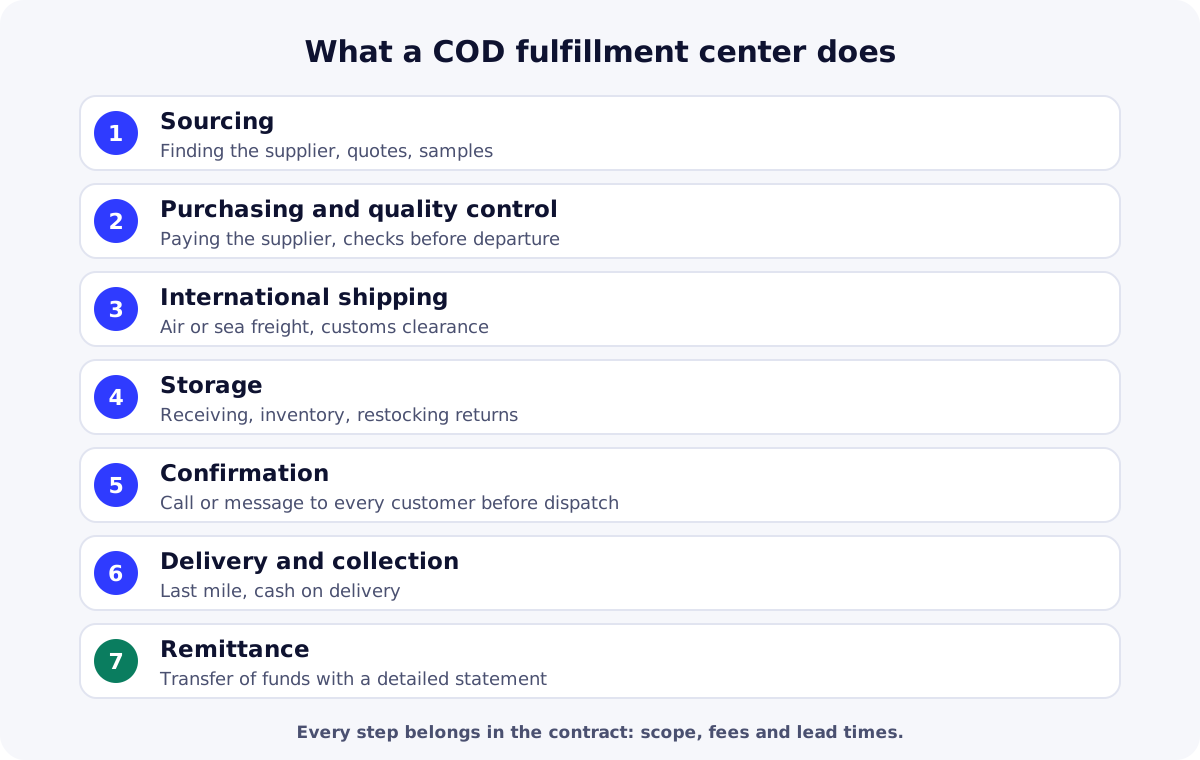
Its role, step by step
| Step | What the center does | What you check |
|---|---|---|
| Sourcing and import | Finds the supplier, negotiates, buys | Purchase price billed, approved sample |
| Quality control | Inspects goods before departure | What is checked, photos provided |
| Freight and customs | Air or sea freight, customs clearance | Price per kg or m³, lead times, duties included or not |
| Storage | Receiving, inventory, shelving | Free or paid, duration, inventory you can view |
| Confirmation | Calls or messages the customer before dispatch | Number of attempts, hours, languages |
| Delivery and collection | Delivers and collects cash on delivery | Zones, lead times, fee per parcel |
| Returns | Recovers refused parcels and restocks them | Any fees, time to restock |
| Remittance | Transfers funds with a statement | Frequency, holdbacks, line-by-line detail |
7 criteria for choosing a COD fulfillment center
1. The countries and cities actually covered
A center rarely covers “Africa” or “the Gulf” as a whole. Ask for the list of countries, cities served and zones with different rates. GibShip, for instance, states that it operates in Senegal and Mauritania, with a different rate for Dakar than for the rest of Senegal. To pick your markets, see also our page on ecommerce in Africa and MENA.
2. A complete, written fee schedule
The fee per delivered parcel is only one line. Ask in writing for the price of each of these items, and when it applies:
- delivery per parcel, in the capital and outside it;
- international freight: price per kg by air, per m³ by sea;
- storage: free, time-limited or billed;
- phone confirmation: included or billed;
- refused parcel or unreachable customer: return fee or not;
- collection and transfer: any commission, bank charges.
Also ask what unit each price applies to. In Morocco, YouCan Ship presents its Fulfill offer (February 16, 2026 article) as “5 services for just 50 MAD”, without saying on that page whether the price is per order, per parcel or per period. That’s exactly the question to settle before comparing.
3. Confirmation quality
This is often where two centers differ most. Ask how many call attempts they make, at what times, in which languages, and whether you get the reason for every cancellation. A good center will let you supply your own confirmation script.
4. Lead times, from China to the customer
Two lead times matter: stock arrival (air or sea) and delivery to the customer once stock is in the country. The first decides when you can start advertising; the second affects your delivery rate, because the longer people wait, the more likely they are to change their minds.
5. Remittance and statements
Insist on a written remittance frequency and a statement per order. GibShip’s terms and conditions provide for weekly remittance with a statement of deliveries, returns and fees, and allow amounts needed for pending returns or delivery disputes to be held back temporarily. That’s the kind of clause to read before signing.
6. Returns and stock handling
A refused parcel should go back into sellable stock, quickly. Ask how long restocking takes, who checks the condition of returned products and how you can view inventory. Without up-to-date inventory you risk running out mid-campaign, or leaving products sitting idle.
7. Integration with your store
The less copy-pasting between your store and the center, the fewer mistakes. Check how orders are sent (integration, file, Google Sheets) and how statuses come back to you.
A real center’s rate card, as an example
To see what a full rate card looks like, here is the one GibShip publishes on its website, as read on October 18, 2026. It is indicative: the center states that actual rates are confirmed by quote once your product catalog has been reviewed.
| Item | Senegal | Mauritania |
|---|---|---|
| Parcel delivered in the capital | 4,500 CFA francs (Dakar) | $6 (Nouakchott) |
| Parcel delivered outside the capital | 6,000 CFA francs | $8 |
| Air freight from China | 10,000 CFA francs/kg, 5 to 7 days | $15/kg, 2 to 3 weeks |
| Sea freight from China | $200/m³, 45 to 60 days | $200/m³, 45 to 60 days |
| Storage | Free, no time limit | Free for the first month |
| Phone confirmation | Included | Included |
With these numbers, a $25 parcel delivered in Nouakchott costs $6 in center fees, or 24% of the selling price, before product and advertising costs. Run this calculation for every center you compare, then plug it into your COD profit calculation.
Questions to ask before you sign
- Which countries, cities and zones do you deliver to, and at what rate for each?
- What do you charge when a customer refuses the parcel or can’t be reached?
- How many confirmation attempts do you make, and do you send me the reason for each cancellation?
- What is your average delivery time once an order is confirmed, and how do you measure it?
- How often do you remit funds, with what statement and what possible holdbacks?
- How can I view my stock, and how long until a return is sellable again?
- Can you buy from China for me, and do you bill the actual supplier price?
- How do I get my stock back if I stop or switch centers?
Red flags
- No contract or written terms and conditions.
- Fees “to be discussed later”, or a rate card that only covers delivered parcels.
- Refusing to provide a per-order statement.
- A “guaranteed” delivery rate: no center controls the customer’s final decision.
- A request to prepay all stock without an approved sample.
- No written remittance schedule.
Do it yourself or hand it to the center?
You can keep some tasks in-house, such as confirmation at the start, to understand your customers better. Here are free and paid tools for each need.
| Need | Free option | Paid option |
|---|---|---|
| Confirm orders | WhatsApp BusinessMessage customers from the small-business app. | The center’s call centerConfirmation by the center, often included in the per-parcel fee. |
| Compare quotes and reconcile statements | Google SheetsOnline spreadsheet, usable with a Google account, to compare rate cards and reconcile statements. | The center’s platformCentralized order and shipment tracking, included in the paid service. |
Key takeaways
Choose a center on paper: a list of countries and cities, a complete fee schedule, a confirmation method, measured lead times, regular remittance and detailed statements. Compare at least two on these criteria, then check their numbers against yours every week. Create your ReadyStore store to keep orders, statuses and analytics in one place.
Sources
- GibShip — Services (accessed 18 October 2026)
- GibShip — Pricing (accessed 18 October 2026)
- GibShip — Terms and conditions (updated July 22, 2026) (accessed 18 October 2026)
- YouCan — Fulfill by YouCan Ship (February 16, 2026) (accessed 18 October 2026)
Frequently asked questions
What’s the difference between a COD fulfillment center and a delivery company?
A delivery company carries the parcel and sometimes collects payment. A fulfillment center also manages stock, order confirmation, packing, returns and remittance, and often imports from China. It coordinates the whole chain, not just the last mile.
How much does a COD fulfillment center cost?
It depends on the country, the city, the weight and the services included. As an example, in October 2026 GibShip listed an indicative $6 per parcel delivered in Nouakchott and 4,500 CFA francs in Dakar, confirmation included, excluding freight from China. Always ask for a written quote and the fees on refused parcels.
Can a fulfillment center buy my products in China?
Many offer this: their agents find the supplier, negotiate and ship the goods to the warehouse. Ask for the supplier invoice or a breakdown of the purchase price, a sample before ordering in volume, and what is inspected before departure.
How can I check that the center’s numbers are right?
Every week, reconcile the center’s statement with your own order statuses: orders sent, confirmed, delivered and returned, and amounts remitted. A one-off gap is often just a date offset; a persistent gap should be flagged and explained line by line.
Can I switch fulfillment centers?
Yes, but plan for it when you sign: notice period, getting your stock back or transferring it, parcels still out for delivery, and the final remittance. Without these clauses, switching centers can lock up your stock and cash for several weeks.
Related guides
How to start a COD ecommerce business without inventory
How to start a COD ecommerce business without inventory or staff: you run the store and ads, a service center handles sourcing, delivery and cash collection.
Read the guideOrder management
Statuses, bulk actions, stock tied to statuses, exports and Google Sheets and logistics integrations.
Learn moreEcommerce in Africa and MENA
Arabic RTL, regional currencies and cash on delivery for markets where it remains common.
Learn more
You launch the store and the ads. The center does the rest.
Create your ReadyStore store: a short COD form, Meta Pixel and Conversions API, orders and analytics in one place.