
How to start a COD ecommerce business without inventory
You can start a COD ecommerce business without renting a warehouse, packing parcels or hiring a delivery team. In a cash on delivery (COD) model built around an ecommerce service center, you keep two jobs: the store and the advertising. The center handles everything else: sourcing in China, purchasing, shipping, storage, order confirmation, delivery, cash collection and sending your money back.
This guide explains how the model really works, who pays for what and when, which numbers to watch, and how to tell whether an offer is profitable before you commit your whole ad budget. It is written for sellers targeting Africa and the Gulf, wherever they live.
What “COD ecommerce without inventory” actually means
“Without inventory” doesn’t mean the goods don’t exist. It means you don’t manage them: stock is bought in small batches and kept in the warehouse of an ecommerce service center in your customers’ country. When an order lands on your store, the center picks it, confirms it with the customer, delivers it and collects payment at the door.
That is different from classic dropshipping, where the supplier ships every parcel from abroad after a card payment. With cash on delivery, the customer pays in cash or by mobile money when the parcel arrives, so the product has to be close by already. Weeks of shipping time would kill the trust that makes people order in the first place.
| Criterion | Classic dropshipping | COD with a service center |
|---|---|---|
| Customer payment | Card, online, at checkout | Cash or mobile money, on delivery |
| Where the product sits | With the supplier, often in China | In the center’s warehouse, in the customer’s country |
| Delivery time | Long: international shipping for every order | Short, once stock has arrived in the country |
| Order confirmation | Not needed: payment is the commitment | Essential: a call or message before dispatch |
| Main risk | Disputes and refunds | Refused parcels and unreachable customers |
Why cash on delivery still dominates in Africa and the Gulf
Access to financial services is the first reason. According to the World Bank’s Global Findex 2025, 79% of adults worldwide now have an account, but that share varies widely from country to country, and owning an account is not the same as being willing to pay an unknown online store in advance.
Trust is the second reason. Many purchases start with an ad on Facebook, Instagram or TikTok for a store the customer has never heard of. Paying on receipt, after seeing the product, removes the fear of never getting it. It’s also why a confirmation call matters so much: it reassures the buyer before anything ships.
The consequence is straightforward: in COD, an order is only an intention to buy. It still has to be confirmed, delivered and paid. Each step loses a share of orders, and that chain, more than the product’s unit cost, decides your margin.
The model: you run the ads, the center does the rest
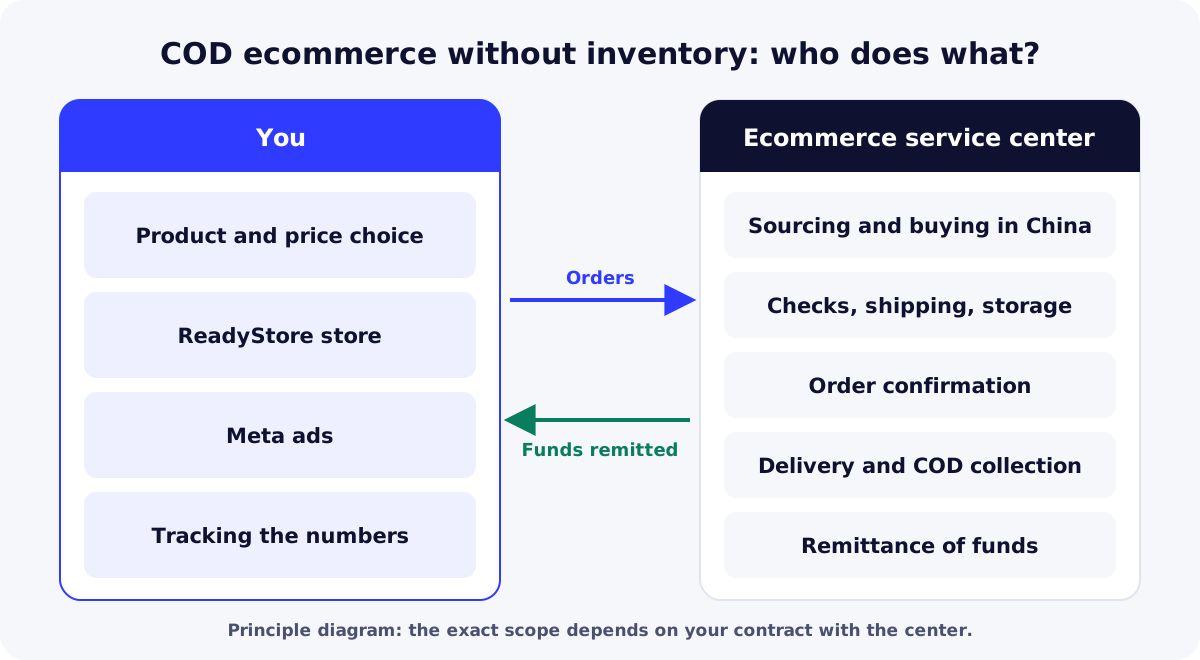
Your side of the work
- Product and offer: which product, at what price, in which bundles (1, 2 or 3 units), with what guarantees.
- The store: a clear product page, photos and videos, a short order form.
- Advertising: creatives, targeting, budget and tests, usually on Meta (Facebook and Instagram).
- Decisions: stop, fix or scale an offer based on real numbers.
The ecommerce service center’s side
- Sourcing and purchasing: finding the supplier (Alibaba, 1688), negotiating, sampling, paying.
- Checks and shipping: inspecting goods, air or sea freight, customs clearance.
- Storage: receiving, inventory, restocking returned parcels.
- Confirmation: a call or message to every customer before dispatch.
- Delivery and collection: last-mile delivery and cash collection.
- Remittance: transferring collected funds with a breakdown of deliveries, returns and fees.
A real example: GibShip lists six services on its services page, from importing from China to cash on delivery collection, with warehouses in Dakar (Senegal) and Nouakchott (Mauritania). Its terms and conditions, updated on July 22, 2026, provide for weekly remittance with a statement of deliveries, returns and fees. Every center has its own countries, rates and rules, so always read the contract.
How to start a COD ecommerce business in 7 steps
- Pick a market and a center. Your target country determines which centers are available, plus lead times and fees. Compare at least two using our guide on how to choose a COD fulfillment center.
- Find a product. Look for a problem that’s easy to show on video, a price that suits cash on delivery, and an item that is light, not fragile and allowed into the target country.
- Have a small batch sourced. Order a sample, then a limited first quantity. The center can negotiate price and minimum order quantity (MOQ) with the supplier.
- Build the store. One product page per offer, bundles and add-ons to lift order value, and a form that only asks for the essentials.
- Set up Meta tracking. Pixel and Conversions API with shared event IDs so nothing is counted twice; see Meta Pixel vs Conversions API.
- Run an ad test. A capped budget, several videos, and stop rules written down in advance (maximum cost per order, number of days).
- Read the numbers and decide. Confirmation rate, delivery rate and cost per delivered order drive the decision, not the number of orders received.
Before your first ad, run through our COD store launch checklist: phone number required, price and delivery fee shown, Pixel tested, stock available at the center.
Tools for each step
| Need | Free option | Paid option |
|---|---|---|
| Spot products that sell | Meta Ad LibrarySearch active ads by keyword and country. | MineaAd and store database; plans from $49 a month. |
| Follow video trends | TikTok Creative CenterTop-performing ads and trends on TikTok. | MineaTrend and competitor tracking across networks. |
| Edit video ads | CapCutOnline video editor, free to use with no credit card. | Canva ProPaid plan with extra templates, assets and tools. |
| Confirm orders | WhatsApp BusinessApp for small businesses: messaging and catalog. | The center’s call centerOften included in the per-parcel fee (it is at GibShip). |
Worked example: profit is measured per delivered order
Take an offer sold for $25 in Mauritania, with a product cost of $5 landed at the warehouse. The confirmation and delivery rates below are working assumptions, not market averages: replace them with your own numbers within the first few days.
| Line | Calculation | Amount |
|---|---|---|
| Confirmed orders | Assumption: 70% | 70 |
| Delivered and paid orders | Assumption: 55% of orders received | 55 |
| Revenue collected | 55 × $25 | $1,375 |
| Cost of products delivered | 55 × $5 | $275 |
| Center fees (delivery in Nouakchott) | 55 × $6 | $330 |
| Advertising | 100 orders × $2 | $200 |
| Margin before other costs | 1,375 − 275 − 330 − 200 | $570 |
| Margin per delivered order | 570 ÷ 55 | ≈ $10.36 |
If the delivery rate drops to 40% on the same budget, the margin falls to $360, or $9 per delivered order, and ad cost per delivered order rises from $3.64 to $5. Nothing changed in the ads; only the confirmation-to-delivery chain got worse. That’s why choosing the center matters as much as choosing the product.
To rerun this with your own figures, follow our COD profit calculation method or use the profitability calculator built into ReadyStore.
Risks to know before you sell online without inventory
- Undelivered orders: refusals, unreachable customers, vague addresses. Depending on the contract, a failed attempt may be billed.
- Cash flow: you pay for stock and ads before money comes back. Weekly remittance leaves days, sometimes weeks, between spending and collecting.
- Dependence on the center: quality of confirmation calls, lead times, accuracy of statements. Ask for detailed figures and compare them with your order statuses.
- Your ad account: follow Meta’s advertising policies, get your business verified and turn on two-factor authentication. Never use multiple or purchased accounts.
- Regulation: some products are banned or restricted at import, and tax obligations vary by country. This is general information: check your situation with a local professional.
The numbers to check every week
| Metric | Calculation | What it tells you |
|---|---|---|
| Confirmation rate | Confirmed orders ÷ orders received | Quality of the offer, targeting and calls |
| Delivery rate | Delivered orders ÷ confirmed orders | Quality of delivery and confirmation |
| Cost per delivered order | Ad spend ÷ delivered orders | Your real acquisition cost |
| Remittance delay | Days between delivery and receiving funds | How much working capital you need |
| Available stock | Units in the center’s warehouse | Risk of running out mid-campaign |
In ReadyStore, order statuses (pending, confirmed, shipped, delivered) and analytics give you the first two rates. Compare them with the center’s statement every week: a persistent gap is the first sign of a problem.
Key takeaways
A COD ecommerce business without inventory lets you start with no warehouse and no team, as long as you treat the service center as a real partner and steer by delivered orders. Pick a market and a center, test one product with a small batch, measure cleanly, then decide. Create your ReadyStore store to run the storefront, Meta tracking and orders in one place.
Sources
- World Bank — The Global Findex Database 2025 (accessed 18 October 2026)
- GibShip — Services (accessed 18 October 2026)
- GibShip — Pricing (accessed 18 October 2026)
- GibShip — Terms and conditions (updated July 22, 2026) (accessed 18 October 2026)
- Meta — Verify your business (accessed 18 October 2026)
- Meta for Developers — Conversions API (accessed 18 October 2026)
Frequently asked questions
Can you really start a COD ecommerce business without inventory?
Yes, as long as an ecommerce service center holds stock for you in the country where you sell. Cash on delivery needs short lead times, so the product must be there before your ads go live. You don’t buy, store or deliver anything yourself, but you do fund the first batch and the advertising.
How is this different from classic dropshipping?
In classic dropshipping the customer pays by card and the supplier ships from abroad, with long lead times. In COD with a service center, stock is already in the country, each order is confirmed by phone and the customer pays on receipt. The risk shifts from refunds to refused parcels.
Do I need a registered company to sell COD in Africa or the Gulf?
It depends on the country you sell in, where you live and the center you choose: some centers require a legal entity, others don’t. Meta’s business verification also asks for official documents. These rules change, so check your situation with a local professional before you start.
How long before I get paid?
Add the delivery time to the center’s remittance cycle. GibShip, for example, states weekly remittance in its terms and conditions. Also count the time for your first batch to arrive: days by air or several weeks by sea, depending on each center’s stated lead times.
Is ReadyStore a fulfillment center?
No. ReadyStore provides the store, the COD order form, Meta Pixel and Conversions API tracking, order management and analytics. Logistics, confirmation, delivery and cash collection are handled by the service center you choose, which can be connected to ReadyStore, as with Gibship.
Related guides
COD fulfillment center: what it does and how to choose one
What a COD fulfillment center does (stock, confirmation, delivery, cash collection) and 7 criteria to choose one: fees, lead times, remittance and statements.
Read the guideCalculating COD profitability
The formula to estimate a COD offer’s margin, accounting for confirmation, delivery and returns.
Learn moreCash on delivery
Everything needed to get paid on delivery: checkout, confirmation, stock, tracking and measurement.
Learn more
You launch the store and the ads. The center does the rest.
Create your ReadyStore store: a short COD form, Meta Pixel and Conversions API, orders and analytics in one place.