
How to sell online in Africa from anywhere in the world
You can sell online in Africa without living there: you run the store and the ads remotely, and an ecommerce service center in the target country stores, confirms, delivers and collects cash for you. So the real question isn’t “where am I?” but “which market should I start with?”.
This guide compares the main zones where cash on delivery is common, gives 2026 connectivity figures by country, lists the criteria that actually matter (center availability, language, currency, price, coverage) and sets out a method to start with one country before adding others.
Can you sell online in Africa without living there?
Yes, with the model described in our guide on how to start a COD ecommerce business without inventory. Everything physical happens in the customer’s country: stock, confirmation, delivery, collection. Everything digital can be run from anywhere: the store, the ads, the numbers. The link between the two is the service center, which you choose with the method in our guide to choosing a COD fulfillment center.
Three things need extra care when you sell from abroad: how the center sends your money (international transfer, local account, FX fees), your ad account (business verification, accepted payment method) and the target country’s regulations. The last one depends on your situation, so check it with a local professional.
Criteria for choosing a COD market
| Criterion | Why it matters | How to check |
|---|---|---|
| A service center on the ground | No local stock or courier means no cash on delivery | Center’s list of countries and cities, written quote |
| Connectivity and audience | Meta ads need a large enough audience | DataReportal reports, Meta audience estimate |
| Language | A page in the customer’s language converts better | Languages spoken day to day, not just official ones |
| Currency and price | Customers compare in local currency, with round prices | Prices charged by local competitors |
| Delivery coverage | The capital is often cheaper to serve than the rest of the country | The center’s rate card by zone |
| Import rules | Some products are banned or heavily taxed | Center, freight forwarder, local professional |
Ecommerce in Africa: the three main COD zones
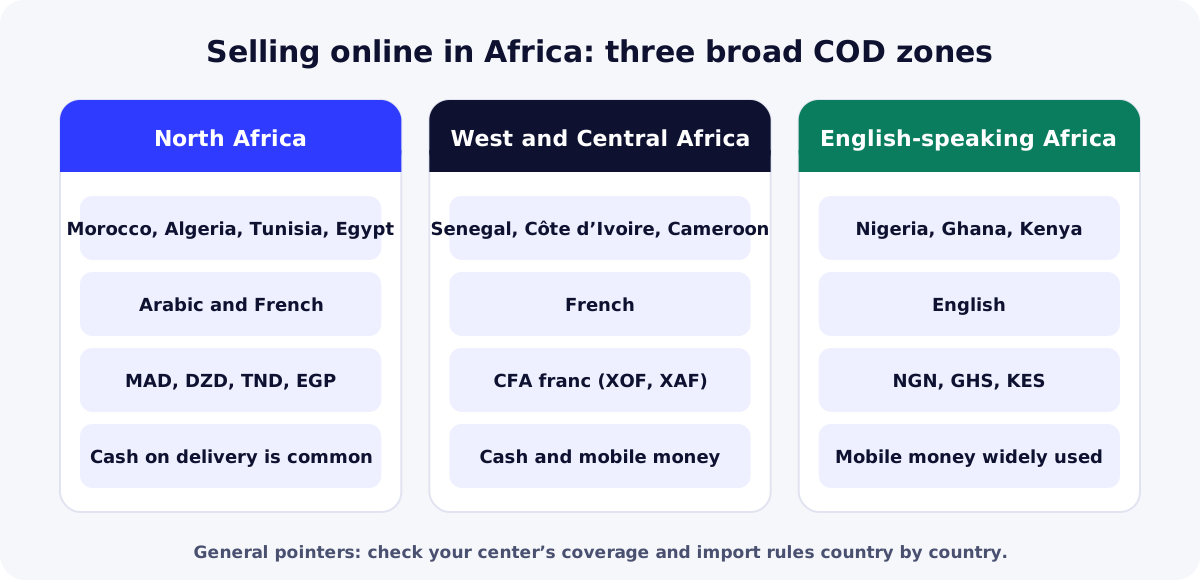
North Africa: Morocco, Algeria, Tunisia, Egypt
The most connected markets on the continent: according to DataReportal, 92.2% of Morocco’s population was online at the end of 2025. You sell in Arabic, and often in French too across the Maghreb, with one currency per country (dirham, dinar, Egyptian pound). Cash on delivery is widespread, and so is competition.
French-speaking West and Central Africa
Senegal, Côte d’Ivoire, Cameroon, Mauritania: a shared selling language, French, and a currency shared by several countries, the CFA franc (XOF in the west, XAF in the center), while Mauritania has its own currency, the ouguiya. Connectivity is lower than in the north, which shrinks the ad audience, but online competition is often thinner. Cash and mobile money dominate payments.
English-speaking Africa: Nigeria, Ghana, Kenya
Very populous English-language markets where mobile money is widely used. Nigeria alone has 109 million internet users according to DataReportal, but at 45.5% penetration: the audience is there, and delivery outside the big cities is the main challenge.
2026 figures by country
| Country | Internet users | Share of population | Facebook ad audience |
|---|---|---|---|
| Morocco | 35.5 million | 92.2% | 22.8 million |
| Algeria | 37.8 million | 79.5% | 27.5 million |
| Tunisia | 10.4 million | 84.3% | 7.80 million |
| Egypt | 98.2 million | 82.7% | 51.6 million |
| Senegal | 11.5 million | 60.6% | 3.60 million |
| Côte d’Ivoire | 13.4 million | 40.7% | 8.40 million |
| Cameroon | 12.6 million | 41.9% | 5.90 million |
| Nigeria | 109 million | 45.5% | 38.0 million |
| Kenya | 23.4 million | 40.5% | 17.0 million |
These numbers show where the audience is, not where you’ll make money. A smaller country with a reliable center and little competition on your product often beats a large market that is saturated or poorly covered for delivery.
Start with one country
Launching three countries at once multiplies centers, currencies, ad creatives and ways to get things wrong. Start with one: one center, one language, one currency. You’ll quickly learn whether your offer, price and confirmation work.
- List the countries covered by the centers you’re considering, with their rates by zone.
- Check your product’s audience in Meta Ads Manager’s estimate for each country.
- Compare local prices for similar products, in local currency.
- Pick one country, get a small batch there and run a limited ad test.
- Measure confirmation rate, delivery rate and cost per delivered order, then decide whether to expand.
When you later add a neighboring country with the same language and currency (say from Senegal to Côte d’Ivoire, both on the XOF CFA franc), most of your work carries over. Our guide on selling in several countries covers that step, and the guide to selling in the Gulf covers GCC markets.
Adapting your offer to each market
- The language people actually use: in North Africa, test Arabic and French; the ad language must match the page.
- Currency and price: show local currency and round amounts, with delivery clearly stated.
- Trust signals: cash on delivery up front, a reachable phone number, written return terms.
- The form: phone number in local format, simple address fields (city, neighborhood, landmark).
| Need | Free option | Paid option |
|---|---|---|
| Market data by country | DataReportalFree Digital reports by country: internet users, social media, audiences. | StatistaStatistics and market studies, full access by subscription. |
| Watch competitors by country | Meta Ad LibrarySee active ads by country before you choose. | MineaAd and store database; plans from $49 a month. |
| Adapt your copy | DeepL TranslatorA first translation draft, to be reviewed by a native speaker. | DeepL ProSubscription with glossaries and higher volumes. |
Risks specific to cross-border selling
- Exchange rates: your costs (product, ads) and your collections are in different currencies, so build in a safety margin.
- Getting funds out: transfer times and fees vary by country; ask the center before you sign.
- Tax and legal status: selling in a country can create obligations even if you don’t live there. General information only: consult a local professional.
- Regulated products: cosmetics, supplements, electronics or health products may require import authorizations.
Key takeaways
You can sell online in Africa from anywhere as soon as a service center covers your market. Pick a first country on concrete criteria (center, audience, language, currency, coverage), adapt the offer, test with a small batch, then expand to neighboring countries. Create your ReadyStore store to sell in each market’s language and currency.
Sources
- DataReportal — Digital 2026: Morocco (accessed 18 October 2026)
- DataReportal — Digital 2026: Algeria (accessed 18 October 2026)
- DataReportal — Digital 2026: Tunisia (accessed 18 October 2026)
- DataReportal — Digital 2026: Egypt (accessed 18 October 2026)
- DataReportal — Digital 2026: Senegal (accessed 18 October 2026)
- DataReportal — Digital 2026: Côte d’Ivoire (accessed 18 October 2026)
- DataReportal — Digital 2026: Cameroon (accessed 18 October 2026)
- DataReportal — Digital 2026: Nigeria (accessed 18 October 2026)
- DataReportal — Digital 2026: Kenya (accessed 18 October 2026)
Frequently asked questions
Which African country is best to start COD ecommerce?
The one where you can access a reliable service center, a large enough audience for your product and reasonable competition. Morocco and Tunisia are highly connected; Senegal and Côte d’Ivoire share the CFA franc and French. There is no universal best country, so test one with a small batch.
Do I need a company in the country where I sell?
Not always: some centers work with foreign sellers, others require a local entity. Tax obligations can also arise from the activity itself. These rules vary by country and change over time, so have your situation checked by a local professional before you start.
How do I get paid if I live abroad?
The center collects in local currency, then remits funds on its schedule, by transfer or to an account you specify. Ask in writing for the remittance currency, exchange and transfer fees, and the delay between delivery and receiving funds.
Which language should I sell in for North Africa?
Arabic and French are both used in the Maghreb; in Egypt, Arabic dominates. The safest approach is to test: one page and ads in each language, then keep whichever gets the best cost per delivered order. The ad language should always match the page.
Can I sell in several countries with a single store?
You can, but one store per country makes currency, language, delivery fees and ad tracking simpler. With ReadyStore, several stores are managed in the same workspace, each with its own products, currency, domain and Meta Pixels.
Related guides
How to start a COD ecommerce business without inventory
How to start a COD ecommerce business without inventory or staff: you run the store and ads, a service center handles sourcing, delivery and cash collection.
Read the guideGetting startedCOD fulfillment center: what it does and how to choose one
What a COD fulfillment center does (stock, confirmation, delivery, cash collection) and 7 criteria to choose one: fees, lead times, remittance and statements.
Read the guideGetting startedCOD ecommerce in Saudi Arabia and the Gulf: a practical guide
COD ecommerce in Saudi Arabia, the UAE, Kuwait and Oman: 2026 audiences, customer expectations, product compliance and the key steps to launch a first country.
Read the guideEcommerce in Africa and MENA
Arabic RTL, regional currencies and cash on delivery for markets where it remains common.
Learn more
You launch the store and the ads. The center does the rest.
Create your ReadyStore store: a short COD form, Meta Pixel and Conversions API, orders and analytics in one place.