
Shipping from China to Africa and the Gulf: air, sea, customs
Shipping from China to Africa (or to the Gulf) decides two things for a COD seller: when your stock is ready for advertising, and what it really costs. A product that looks profitable on paper can stop being so once volumetric-weight freight and import duties are added.
This guide compares air and sea freight, explains how pricing works (actual weight, volumetric weight, volume), what the main Incoterms mean, and what to know about customs in West Africa and the Gulf, with official sources.
Shipping from China to Africa: air or sea?
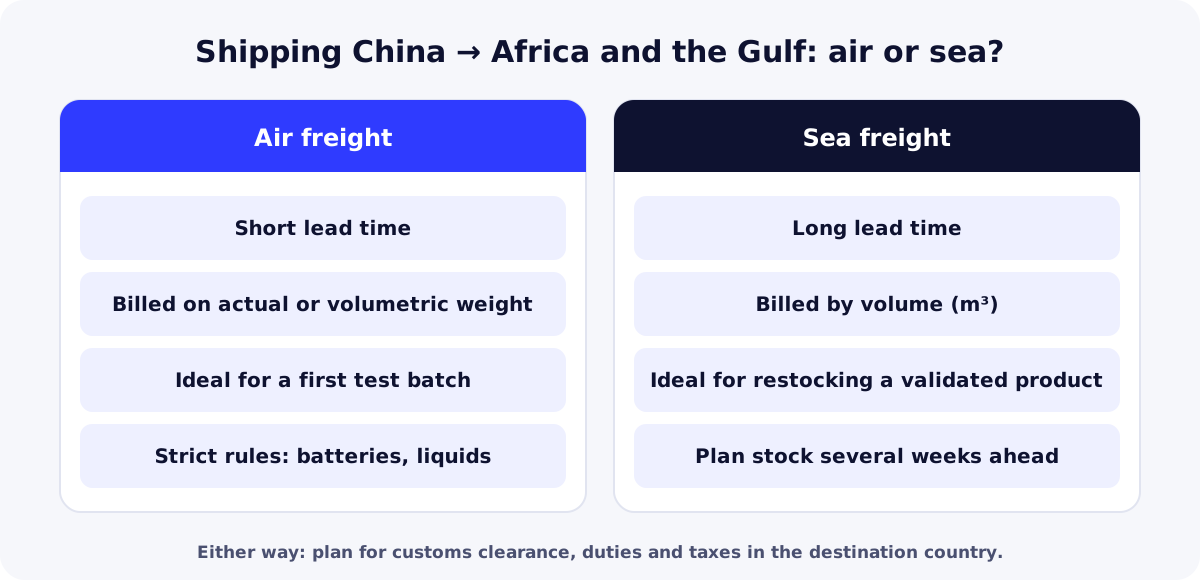
A real rate card: in October 2026, GibShip listed indicative rates of 10,000 CFA francs/kg by air to Senegal (5 to 7 days), $15/kg to Mauritania (2 to 3 weeks), and $200/m³ by sea (45 to 60 days) to both countries.
| Situation | Suggested mode | Why |
|---|---|---|
| First test batch, small volume | Air | You launch ads fast and keep little stock tied up |
| Validated product, regular restock | Sea | Much lower cost per unit at volume |
| Heavy or bulky product | Sea, or drop it | Air freight by weight can exceed the margin |
| Product with a lithium battery | Depends on the carrier | Dangerous goods by air, strict rules |
| Stockout on a winning product | Air as a top-up | Don’t cut a profitable campaign |
How freight pricing works
Volumetric weight in air freight
By air, a light but bulky parcel is billed at its volumetric weight if that exceeds the actual weight. DHL Express gives the formula: length × width × height (in cm) ÷ 5,000. The divisor varies by carrier, so ask yours.
| Calculation | Result |
|---|---|
| Volumetric weight (divisor 5,000) | 40 × 30 × 20 ÷ 5,000 = 4.8 kg |
| Billed weight | 4.8 kg (the higher of the two) |
| Cost at $15/kg (GibShip Mauritania rate) | $72 instead of $45 |
Volume in sea freight
By sea, consolidated shipments are usually billed per cubic meter. One cubic meter is, for example, 25 cartons of 40 × 50 × 20 cm. Optimizing packaging with the supplier (full cartons, nested products) directly lowers the cost per unit.
The Incoterms to know
Incoterms, published by the International Chamber of Commerce (ICC), set who pays for what and who carries the risk during transport. The most common for a small importer, as explained by the ICC Academy:
| Incoterm | In practice | For you |
|---|---|---|
| EXW (Ex Works) | The seller makes the goods available at its premises | You (or your agent) arrange everything else |
| FOB (Free On Board) | The seller delivers the goods on board the vessel at the port of shipment | You pay sea freight and what follows |
| CIF (Cost, Insurance and Freight) | The seller pays port-to-port carriage and minimum insurance | You handle arrival and customs |
| DAP (Delivered At Place) | The seller delivers to the agreed place, not unloaded | You pay customs and taxes |
| DDP (Delivered Duty Paid) | Risk passes to the buyer only at destination, duties paid by the seller | Simplest, often most expensive |
Customs: what to plan for
In the Gulf
Gulf Cooperation Council countries form a customs union. According to the UAE federal authority (ICP), it applies a 5% duty on foreign goods imported from outside the union, with a list of exemptions. In Dubai, the UAE government portal states that the 5% duty applies to the CIF value, with higher rates for alcohol and cigarettes. VAT and compliance rules (such as SABER in Saudi Arabia) come on top.
In West Africa (ECOWAS)
ECOWAS countries apply a common external tariff in five categories, according to the ECOWAS Trade Information System: 0% for essential social goods, 5% for goods of primary necessity, raw materials and capital goods, 10% for intermediate goods, 20% for final consumption goods, 35% for specific goods. Other levies and national VAT may be added.
| Zone | Stated base rate | Customs duty alone |
|---|---|---|
| Gulf (customs union, most goods) | 5% | $50 |
| ECOWAS, final consumption goods (category 3) | 20% | $200 |
Useful official sites: Senegal Customs, Côte d’Ivoire Customs, Algeria Customs, Morocco Customs (ADII), ZATCA in Saudi Arabia, Dubai Customs in the UAE.
Planning stock around lead times
- Test: small batch by air, ads launched as soon as stock is in.
- Validation: if the product works, order the sea restock before the air stock runs out.
- Safety: keep a small buffer and an air fallback to avoid stockouts during a profitable campaign.
- Tracking: compare quantities received by the center with the order (breakage, shortages).
| Need | Free option | Paid option |
|---|---|---|
| Calculate volumetric weight and costs | Google SheetsSpreadsheet to compare air, sea and duties. | Ecommerce service centerFreight and delivery quote to the warehouse (paid). |
| Estimate duties and taxes | Senegal Customs (simulator)Official site with duty and tax tools. | Freight forwarder or customs brokerClassification, declaration and clearance (paid service). |
Key takeaways
When shipping from China to Africa or the Gulf: air to test, sea to restock, watch volumetric weight and packaging, agree a clear Incoterm and cost duties in advance. Get a quote up to your center’s warehouse (see our guide on using a China sourcing agent) and fold it into your startup budget. Create your ReadyStore store to sell as soon as stock lands.
Sources
- GibShip — Pricing and lead times (accessed 18 October 2026)
- DHL Express — Calculating volumetric weight (accessed 18 October 2026)
- ICC — Incoterms 2020 (accessed 18 October 2026)
- ICC Academy — EXW or DDP (accessed 18 October 2026)
- ICP (UAE) — GCC Customs Union (accessed 18 October 2026)
- UAE government portal — Customs clearance and duty (accessed 18 October 2026)
- ECOTIS (ECOWAS) — Common External Tariff (accessed 18 October 2026)
- IATA — Shipping lithium batteries (accessed 18 October 2026)
Frequently asked questions
How long does shipping from China to Africa take?
It depends on the mode and destination. As an example, GibShip’s October 2026 rate card states 5 to 7 days by air to Senegal, 2 to 3 weeks to Mauritania, and 45 to 60 days by sea. Add production, customs clearance and receipt at the center.
How do I calculate volumetric weight?
Multiply the parcel’s length, width and height in centimeters, then divide by the carrier’s divisor: DHL Express uses 5,000. The billed weight is the higher of actual and volumetric weight. Ask your provider for their exact divisor.
What customs duties apply in the Gulf?
The Gulf customs union generally applies 5% on foreign goods, with a list of exemptions, according to the UAE federal authority. In Dubai, the duty applies to the CIF value. Each country’s VAT and compliance rules come on top: check your specific product.
What customs duties apply in West Africa?
ECOWAS applies a common external tariff in five categories, from 0% to 35%; final consumption goods fall in the 20% category. Additional levies and national VAT may apply. Exact classification should be checked with customs or a freight forwarder.
Which Incoterm should a beginner use?
With an agent or service center, the simplest is usually for them to arrange freight from their warehouse in China to yours. If you deal directly with a supplier, DDP simplifies customs but often costs more; EXW leaves everything to you.
Related guides
China sourcing agent: quotes, samples, MOQ and lead times
Working with a China sourcing agent or ecommerce center: product brief, quotes, samples, MOQ, lead times, payment, inspection and the traps to avoid.
Read the guideGetting startedCOD dropshipping startup cost: how much do you need?
COD dropshipping startup cost: stock, freight, test ad spend, center fees and a cash reserve, with a worked example and a method to size your own budget.
Read the guideGetting startedCOD ecommerce in Saudi Arabia and the Gulf: a practical guide
COD ecommerce in Saudi Arabia, the UAE, Kuwait and Oman: 2026 audiences, customer expectations, product compliance and the key steps to launch a first country.
Read the guideOrder management
Statuses, bulk actions, stock tied to statuses, exports and Google Sheets and logistics integrations.
Learn more
You launch the store and the ads. The center does the rest.
Create your ReadyStore store: a short COD form, Meta Pixel and Conversions API, orders and analytics in one place.