
COD delivery rate: the numbers to demand from your center
Your COD delivery rate is the number that decides your margin: an undelivered order costs ad spend, sometimes return fees, and brings in nothing. Yet many sellers track it poorly, or take their center’s percentage at face value without knowing how it’s calculated.
This guide gives exact definitions of the rates to track, the statements to demand from your service center, how to reconcile them with your own orders, and a grid to diagnose a falling rate. You won’t find a “market average” here: there’s no reliable public source, and only your own numbers count.
COD delivery rate: the definitions to agree on
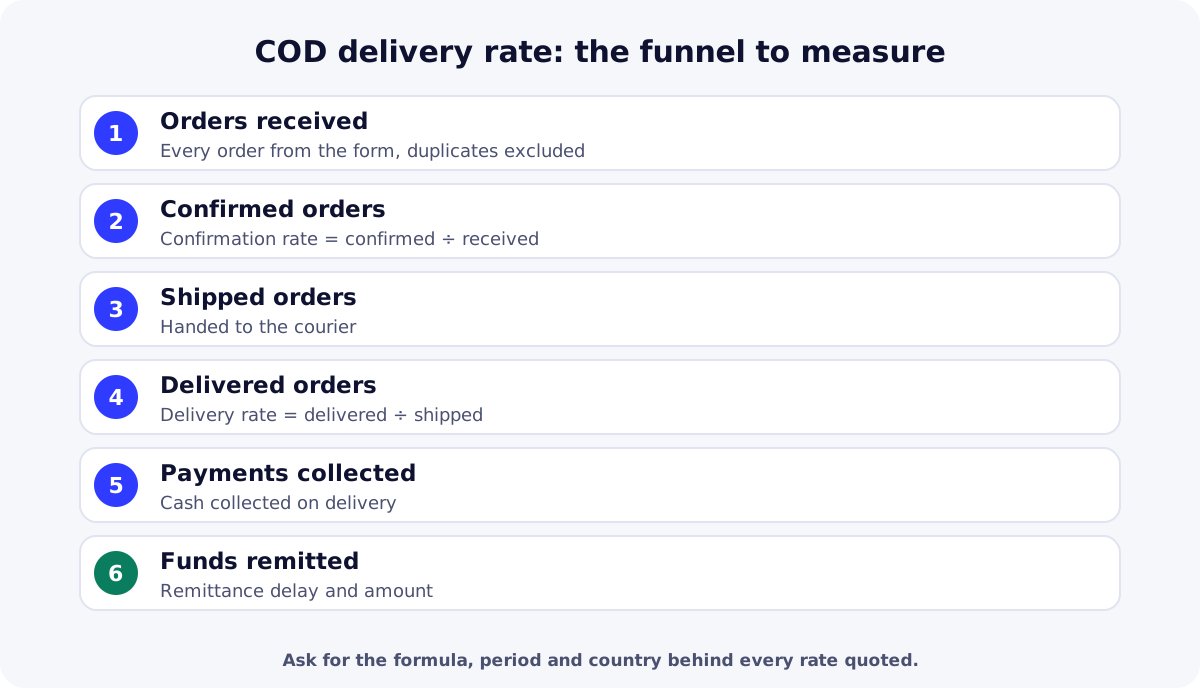
| Rate | Formula | What it measures |
|---|---|---|
| Confirmation rate | Confirmed ÷ received (duplicates and tests excluded) | Quality of the offer, targeting and calls |
| Delivery rate | Delivered ÷ shipped | Quality of delivery and confirmation |
| Overall rate | Delivered ÷ received | The real yield of your advertising |
| Return rate | Returned or refused ÷ shipped | Parcels that cost without paying |
| Delivery time | Days between confirmation and delivery | Risk of the customer changing their mind |
| Remittance delay | Days between delivery and receiving funds | Your cash-flow needs |
Example: the same month, three different rates
| Step | Count | Rate |
|---|---|---|
| Orders received | 400 | — |
| Confirmed orders | 280 | Confirmation: 280 ÷ 400 = 70% |
| Shipped orders | 270 | — |
| Delivered orders | 216 | Delivery: 216 ÷ 270 = 80% |
| Overall rate | 216 out of 400 | 216 ÷ 400 = 54% |
Use the overall rate to calculate ad cost per delivered order and real margin, as in our guide on starting a COD ecommerce business without inventory and the COD profit calculation method.
Statements to demand from your center
A serious center provides a detailed statement. GibShip’s terms and conditions, for example, provide for weekly remittance with a detailed statement of deliveries made, returns and applicable fees. Ask, at minimum, for each order:
- your order number (for reconciliation);
- dates: received, confirmed, shipped, delivered or returned;
- the final status and the reason for cancellation or refusal;
- the amount collected and fees applied (delivery, return, other);
- the amount remitted and transfer date, with any holdbacks.
Reconciling the statement with your orders
- Export your orders for the period (status, date, amount).
- Match each statement line to your order number.
- List the gaps: delivered at the center but not on your side, different amount, unexpected fees, order missing from the statement.
- Ask for a written explanation for each persistent gap.
- Recalculate your rates from reconciled numbers, not quoted ones.
Diagnosing a falling rate
| Symptom | Likely causes | Actions |
|---|---|---|
| Confirmation falling | Targeting too broad, vague offer, late call, fake numbers | Call back faster, clarify price and lead time, check the form |
| Delivery falling | Lead time too long, unreachable customer, wrong address | Shorten lead time, confirm address and a landmark |
| Returns rising on one product | Disappointing product, misleading photos | Review quality, product page and promises |
| Gaps with the statement | Unsynced statuses, data-entry errors | Weekly reconciliation, written explanation |
| Remittance delay growing | Holdbacks, disputes, center delays | Reread the contract, ask for holdback details |
Confirmation is often the quickest lever: see our guide on COD order confirmation. To choose or change center, see the guide to choosing a COD fulfillment center.
| Need | Free option | Paid option |
|---|---|---|
| Reconcile statements and orders | Google SheetsOnline spreadsheet, usable with a Google account. | Microsoft Excel (Microsoft 365)Spreadsheet included in Microsoft 365 subscriptions. |
| Visualize rate trends | Looker StudioDashboards connected to Google Sheets, free. | Service center platformOrder and shipment tracking included in the center’s paid service. |
Key takeaways
A COD delivery rate only makes sense with its formula. Track confirmation, delivery and overall rates over the same period, demand a per-order statement, reconcile weekly and diagnose gaps. Create your ReadyStore store to track your real rates from your own orders.
Sources
- GibShip — Terms and conditions (updated July 22, 2026) (accessed 18 October 2026)
Frequently asked questions
What is a good COD delivery rate?
There is no reliable public average: figures in circulation often come from vendors, with no formula or period. A good rate is one that keeps your offer profitable per delivered order. Measure yours, by country and product, and track how it moves.
What’s the difference between confirmation rate and delivery rate?
Confirmation rate measures the share of received orders the customer confirms (by call or message). Delivery rate measures the share of shipped orders actually delivered and paid. The overall rate, delivered divided by received, combines both.
What should an ecommerce center’s statement include?
For each order: your number, dates, final status, cancellation or refusal reason, amount collected, fees applied, amount remitted and transfer date, with any holdbacks. Without that detail, you can’t check the numbers.
How do I reduce refused parcels?
Confirm quickly and clearly (price, lead time, address), shorten delivery time, avoid exaggerated promises and look after product quality. The detailed refusal reasons in your center’s statement show where to act first.
How often should I check my rates?
At least weekly, in step with statements and remittances, and daily during a product test. Always compare the same period and country, otherwise changes are meaningless.
Related guides
COD order confirmation: do it yourself or delegate, plus a script
COD order confirmation: call or WhatsApp, doing it yourself or using a center, a full call script, answers to objections and the statuses to record.
Read the guideGetting startedCOD fulfillment center: what it does and how to choose one
What a COD fulfillment center does (stock, confirmation, delivery, cash collection) and 7 criteria to choose one: fees, lead times, remittance and statements.
Read the guidePillar guideHow to start a COD ecommerce business without inventory
How to start a COD ecommerce business without inventory or staff: you run the store and ads, a service center handles sourcing, delivery and cash collection.
Read the guideAnalytics and profitability
Order statistics, expenses and a COD profitability calculator to steer your margin.
Learn more
You launch the store and the ads. The center does the rest.
Create your ReadyStore store: a short COD form, Meta Pixel and Conversions API, orders and analytics in one place.