
Cost per delivered order: measuring real COD profit each week
Your cost per delivered order is the number that tells you whether a COD product really makes money. Neither the order count nor Meta’s cost per purchase can tell you that: profit only shows once parcels are delivered, paid and remitted, and once every cost is counted, including those of orders that brought nothing in.
Our resource on calculating COD profitability gives the formula for estimating an offer before launch. This guide is for afterwards: how to run a real weekly review for each product from your own numbers, and how to decide whether to keep, fix or stop.
What goes into the cost per delivered order
| Cost | Applies to | Where to find it |
|---|---|---|
| Product landed cost | Delivered orders | Purchase, shipping to the country, customs, packaging |
| Delivery and service fees | Delivered orders | Center’s quote and statement |
| Return or refusal fees | Undelivered parcels | Center’s statement |
| Ad spend | All orders, delivered or not | Ads Manager |
| Confirmation (if billed) | Orders handled | Center contract or salary |
| Fixed costs | The period | Subscriptions, tools, team |
Calculating cost per delivered order and result
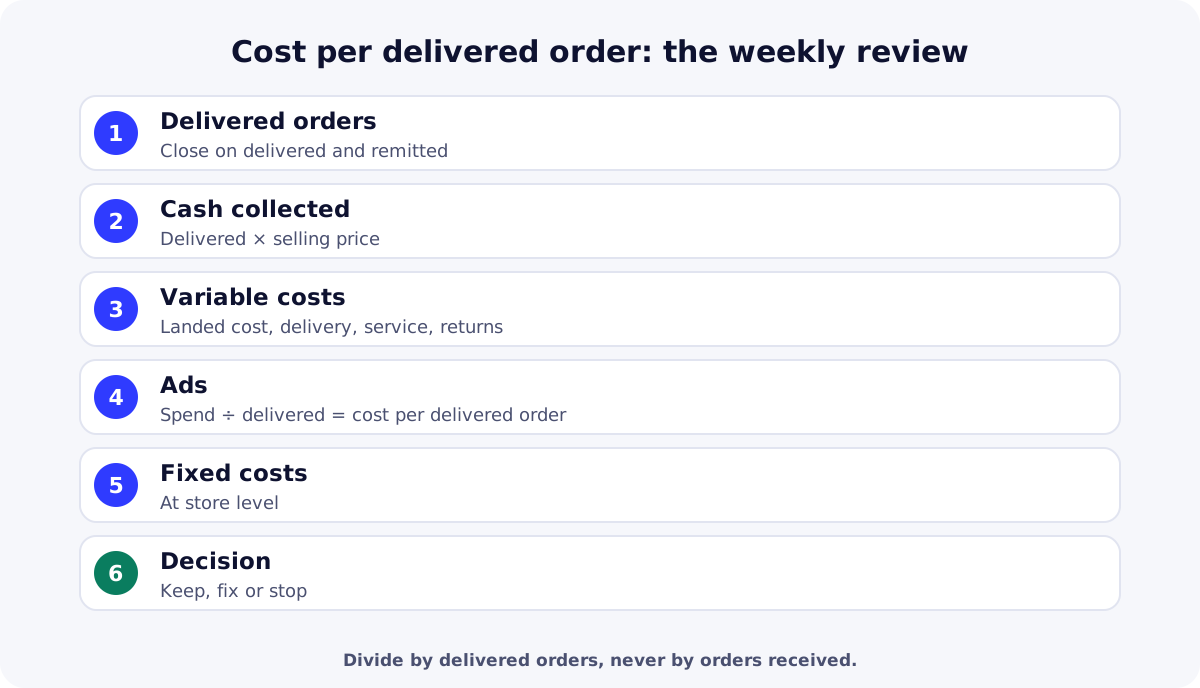
- Ad cost per delivered order = ad spend ÷ delivered orders.
- Margin before ads = cash collected − landed cost − delivery and service fees − return fees.
- Maximum ad cost per delivered order = margin before ads ÷ delivered orders.
- Product result = margin before ads − ad spend.
| Line | Calculation | Result |
|---|---|---|
| Orders received / confirmed / delivered | — | 120 / 84 / 66 |
| Parcels returned or refused | 84 − 66 | 18 |
| Cash collected | 66 × 40 | 2,640 |
| Landed cost | 66 × 11 | −726 |
| Delivery fees | 66 × 7 | −462 |
| Return fees | 18 × 4 | −72 |
| Margin before ads | 2,640 − 726 − 462 − 72 | 1,380 |
| Ad spend | — | −600 |
| Ad cost per delivered order | 600 ÷ 66 | 9.09 |
| Maximum ad cost per delivered order | 1,380 ÷ 66 | 20.91 |
| Product result | 1,380 − 600 | 780 |
The weekly review, product by product
- Close the week on delivered and remitted orders (see COD remittance).
- Reconcile deliveries, returns and fees with the center’s statement (see COD delivery rate).
- Record the product’s ad spend over the same period.
- Calculate margin before ads, cost per delivered order and result.
- Take off fixed costs at store level, not product level.
- Compare with previous weeks before deciding.
A week’s deliveries often relate to the previous week’s orders: keep the same cut-off rule from one week to the next, or comparisons mean nothing.
Keep, fix or stop
| Situation | Reading | Decision |
|---|---|---|
| Positive, stable result | The product covers its ads with margin | Keep, then increase gradually (see how to scale a COD business) |
| Positive but falling result | Creatives wearing out or confirmation weakening | New creatives, check confirmation |
| Cost per delivered order close to the maximum | No safety margin | Fix the offer (price, bundle) or confirmation before increasing |
| Negative result | The product loses money on every paid parcel | One targeted fix at most, then stop |
| Need | Free option | Paid option |
|---|---|---|
| Keep a review per product | Google SheetsOne row per product per week. | Microsoft Excel (Microsoft 365)Spreadsheet included in Microsoft 365 subscriptions. |
| Track trends over time | Looker StudioCharts connected to Google Sheets, free. | QuickBooksAccounting and reports, subscription. |
Key takeaways
Cost per delivered order is measured on delivered orders, with every cost: landed cost, delivery, returns, ads, then fixed costs. Each week, calculate each product’s cost per delivered order and result, compare with the maximum and decide with a stable grid. Create your ReadyStore store to track these numbers product by product.
Sources
- GibShip — Pricing (accessed 18 October 2026)
- GibShip — Terms and conditions (updated July 22, 2026) (accessed 18 October 2026)
Frequently asked questions
How do I calculate a COD product’s profit?
Over a period, take cash collected from delivered orders, subtract landed cost, delivery and service fees, return fees and the period’s ad spend. The result divided by delivered orders gives profit per delivered order.
What is cost per delivered order?
Ad spend divided by the number of orders actually delivered and paid. It’s always higher than cost per order received, because some orders are never confirmed or delivered.
How is this different from the profitability calculator?
The calculator estimates an offer from assumptions (rates, costs) before you spend. The weekly review starts from your real numbers, delivered orders and actual spend, to decide whether to keep, fix or stop.
Should I include fixed costs?
Yes, but at store level: subscriptions, tools and team don’t depend on one product. A product can be profitable on its own while the store loses money if fixed costs are too high for the volume.
What margin should I aim for in COD dropshipping?
There’s no reliable universal figure. Aim for an ad cost per delivered order well below your maximum, to keep a safety margin against swings in delivery rate and ad cost.
Related guides
COD delivery rate: the numbers to demand from your center
COD delivery rate and confirmation rate: exact definitions, statements to demand from your center, reconciling them with your orders and diagnosing gaps.
Read the guideOperationsCOD remittance: how to check the cash collected for you
COD remittance explained: how the cash flows, clauses to demand from your center, reading a statement, holdbacks, cash flow and the warning signs to watch.
Read the guideProfitabilityHow to scale a COD business: when and how to speed up
Scale a COD business without losing margin: conditions to meet, budget increases in steps, new creatives, countries and products, stock, center and cash flow.
Read the guideCalculating COD profitability
The formula to estimate a COD offer’s margin, accounting for confirmation, delivery and returns.
Learn more
You launch the store and the ads. The center does the rest.
Create your ReadyStore store: a short COD form, Meta Pixel and Conversions API, orders and analytics in one place.